
What is Data Cabling?
Data cabling is the process of creating an IT network using data cables. IT, or information technology, refers to any piece of equipment that is used for creating, storing, managing, or transmitting information that is stored in a digital format. A cable-linked IT network usually includes personal computers, printers, wi-fi routers, and servers. Sometimes, it includes telecommunication devices such as wired phones and radios. Commercial IT networks often integrate more sophisticated devices such as security cameras, access controllers, and audiovisual equipment. All three systems are considered low-voltage electrical systems, as they only operate between 1 and 600 volts.
A well-constructed IT data cable system transfers information within the system more efficiently and reliably. Additionally, a reliable network is also one that is resistant to cybersecurity attacks and environmental wear and tear. Lastly, a good system is well concealed within walls and data cabinets.
Types Data Cables
There are two main types of data cables:
Copper Cables
Copper cables connect IT devices that are within close distance of each other to a data cabinet. A CAT5E copper cable is the cheapest type of data cable and transmits information at a speed of up to 1000 megabits per second over 328 feet. It’s a high signal integerty reliably communicates data between devices. On the other hand, the more expensive CAT6 data cable transmits data at the speed of upto 10,000 megabits per second over the same limited distance. Ethernet connections are the most common use for CAT6 cables.
Fiber Optics Cables
Fiber Optic Cables are made out of flexible glass tubes that allow light and information to travel vast distances. A fiber cable’s max speed is 10,000 megabits, like the CAT6 data cable, but it’s able to transmit information over a distance of up to 1.25 miles. Fiber Optic cable can be either multimodal or single-mode. Multimodal fiber optic cables are best for creating an IT network system for a small commercial space or residence. Single-mode fiber optic cables are optimal for large commercial spaces or enterprises that have a large remote workforce.
Data Cabinets
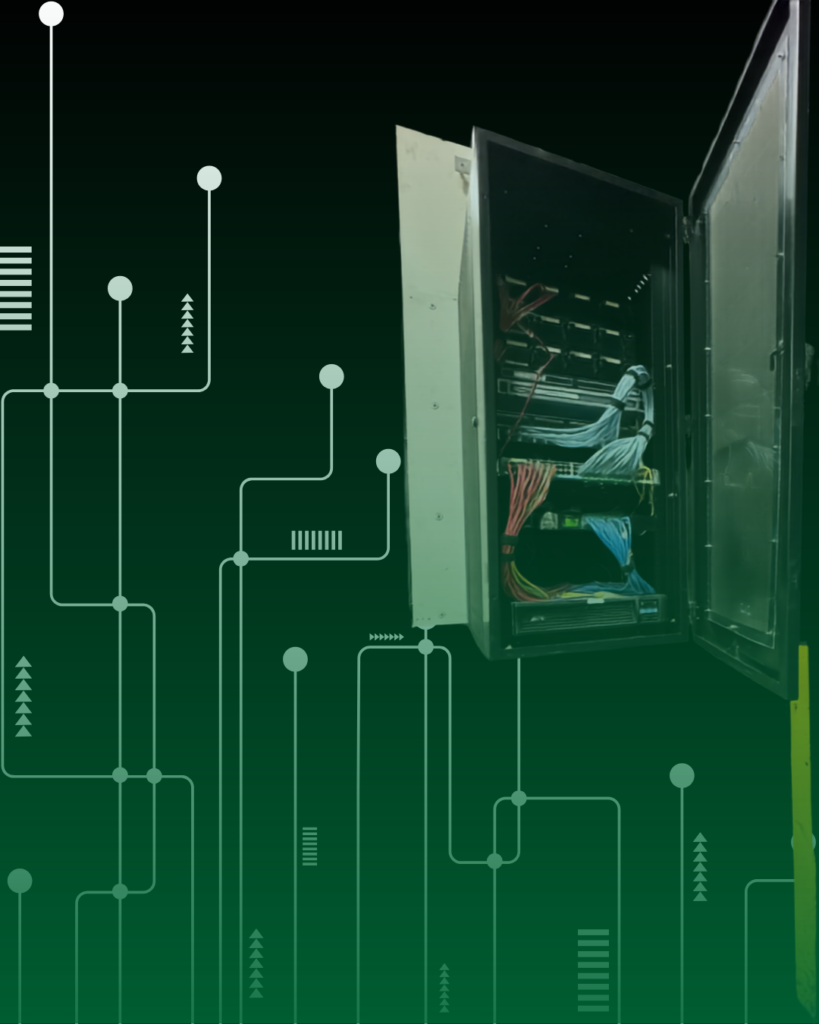
Data Cabinets contain patch panels that connect cables with other network equipment, such as modems, routers, and switches. Access to these cabinets should be restricted to protect the overall cybersecurity of the rest of the network. It is best if these cables are organized and arranged correctly the first time
The cabling within these cabinets should be organized and arranged correctly the first time, as its near imposible to rearrange them in the future. Using color coding and durable tags is considered the best practice to achieve this.
TLDR…
Data cables link digital devices into an IT network. Smaller IT cable networks use copper cables to create these networks. Larger IT cable networks need fiber optics cable to transmit data over long distances. All IT networks that use cables need to use a data cabinet to organize the cables and network equipment.
Continue reading
 Data Cabling
 Why Structured Cabling for Warehouses Matters in Expanding Industrial Facilities
Structured Cabling for Warehouses: Essential Tips for Growth Structured cabling for warehouses becomes especially important when an industrial facility adds more employees, equipment, storage areas, production lines, cameras,…
 Data Cabling
 Onsite IT Support for Medical and Dental Practices Advantages
When Should a Medical or Dental Practice Bring in Onsite IT Support? Small medical and dental practices depend on technology all day, even when they do not feel…
 Data Cabling
 IT Support for Healthcare Practices: 5 Issues Small Medical and Dental Offices Should Catch Early
IT Support for Healthcare Practices: 5 Issues Small Medical and Dental Offices Should Catch Early Small IT issues can disrupt a medical or dental office faster than most…
Need expert IT, networking, or low-voltage support?
Our team designs, deploys, and supports IT, structured cabling, Wi-Fi, security cameras, and audio-visual systems for businesses across all 50 states — backed by 24/7/365 service and BICSI-certified installers.