


5 Ways Responsive IT Field Services Cut Factory Downtime

Downtime in industrial operations costs more than lost minutes. In a San Antonio plant or distribution center, a stopped production line or a failed barcode scanner can lead to missed shipments, overtime, and higher freight costs. Often the cause is physical infrastructure rather than software. Marginal cabling, poor wireless coverage, or incomplete access control installs break systems that require reliable local connectivity. Responsive IT field services with strong onsite IT support fix urgent problems faster, prevent recurring failures, and make deployments repeatable so new equipment works from day one.
This article explains five practical ways responsive IT field services cut downtime in manufacturing and warehousing in San Antonio, Texas, United States. You’ll learn how faster recovery lowers MTTA and MTTR, how proactive checks prevent outages, why repeatable network deployments and structured cabling matter, how to improve wireless coverage, and how to coordinate multi-vendor work including access control and security. Finally, we cover which KPIs to track, a short 90-day pilot you can run, and how to choose a partner for reliable onsite IT support.
1) Faster recovery, lower MTTA and MTTR
When a production line stops, two simple measurements matter most: MTTA, the mean time to arrive, and MTTR, the mean time to repair. Responsive field services lower both by combining fast triage with local inventory and a strict first-visit fix focus. The process begins with remote diagnostics to isolate the fault so the dispatched technician carries the correct spare parts or a pre-staged kit. Regional stock and planned routing reduce travel time. A high first-visit fix rate avoids multiple site visits, reduces repair labor, and shortens the total downtime window, which protects shipment schedules and reduces emergency costs.
How to measure recovery performance:
- Make MTTA and MTTR primary operational metrics for priority incidents and report them weekly to stakeholders. Track first-visit fix rate, number of repeat visits, and downtime minutes per incident to show trends. Include incident priority (P1, P2) in reports so operations and finance can see the true cost per failure. If you are changing your incident model, consider formalizing incident intake and mapping it to an onsite IT support plan so dispatch and escalation happen consistently and predictably across San Antonio facilities.If you need faster onsite response, our onsite IT support plans can help. Learn more: commercial IT services
2) Proactive checks that stop outages
Reactive, break-fix support is costly and unpredictable. A proactive program finds issues before they escalate and stops many outages. Common proactive tasks include wireless health checks to detect roaming or interference, structured cabling inspections and certification to surface marginal links, and controlled firmware reviews staged during planned maintenance windows.
Wireless health checks reveal roaming failures that can interrupt warehouse management systems. Structured cabling inspections ensure connectors and runs will hold up under operational load. Firmware reviews catch device updates that might otherwise introduce failures. Regular preventive work reduces incident frequency and keeps systems stable during peak shifts.
Measure success by comparing incident counts before and after the program, tracking the percentage of incidents avoided by preventive actions, and monitoring the success rate of scheduled changes. Pair proactive checks with formal network deployments to make sure wired and wireless changes are coordinated and validated together.
3) Fast, repeatable network deployments
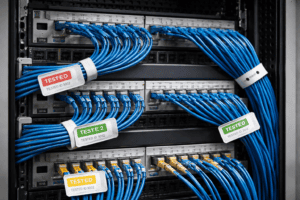
Manufacturing and distribution sites change often. New lines, rearranged layouts, and seasonal needs require fast and accurate infrastructure work. Repeatable network deployments reduce risk by using pre-staged kitting, standard runbooks, and mandatory as-built documentation.
Why structured cabling and network deployments matter:
- Pre-staged kitting shortens onsite assembly time and prevents missing-part delays. Runbooks create consistent installation steps across locations and crews. As-built documents and test reports create a clean handover that speeds future troubleshooting. Structured cabling and properly executed network deployments are the foundation for automation. Poor cabling network devices often produce intermittent failures that only appear weeks after installation. Measure deployment success by tracking time from request to operational readiness, rework and corrective visit rates, and completeness of handover documents. Require test certificates and as-built records before signoff to reduce the chance of downstream downtime.
4) Better wireless coverage, fewer intermittent failures
Wireless networks power handheld scanners, AGVs, and IoT sensors. Dead zones, metal reflections, and poor antenna placement generate rescans, failed transactions, and device dropouts that are hard to trace. Responsive field teams address wireless issues with a plan. They begin with an RF survey to map coverage and interference, remediate physical and configuration problems such as AP placement and antenna type, tune channels and power, and then validate performance during peak operations to ensure the network holds up under real load.
Case study: A real manufacturing case demonstrates this approach. The “No Downtime. No Compromise” wireless case study documents predictive design, RF surveys, targeted corrections, and validation testing that reduced wireless failures to near zero and delivered measurable uptime improvements. The case study here: No Downtime. No Compromise shows how disciplined wireless design and validation stop recurring failures and improve output. Implementing this process across San Antonio facilities would deliver comparable reliability improvements.
5) Coordinate vendors, stop the finger-pointing
Most industrial sites engage multiple vendors for cabling, networking, security, and OT systems. When an incident spans teams, unclear ownership and poor documentation slow resolution. A responsive field services provider acts as an integrator, coordinating vendors through a single runbook and a RACI matrix that assigns ownership for every task. Appoint a lead technician onsite to manage handoffs, escalations, and quality checks. Require as-built photos and documentation for each job so troubleshooting does not stall while teams chase missing information.
Access control and camera systems are often part of the same physical project. Improper planning for access control installs can cause unplanned site access issues and outages. Include access control integration and testing as part of structured cabling and network deployments so security devices have the correct provisioning from the start. Track vendor response time, handover time between teams, and incidents that require vendor escalation. Reducing handoff friction is one of the fastest ways to cut total downtime across a facility.
Measure success and show ROI
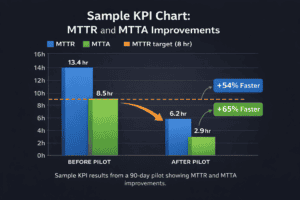
Proving the value of responsive field services requires a short, focused KPI set. Track MTTA and MTTR by priority, first-visit fix rate, incident frequency and downtime minutes per month, backlog age from request to completion, and SLA adherence with stakeholder satisfaction. Translate these metrics into dollars by multiplying downtime minutes saved by production throughput or labor cost per minute, and add avoided rework and fewer expedited shipments for a full ROI view.
A simple Downtime Savings Calculator or spreadsheet helps present the business case to operations and finance teams in San Antonio. Use pilot KPI data to refine dispatch rules, inventory placement, and the scope of proactive work. When pilots show clear results, scale the program across other facilities.
If you need help building an ROI model, we can walk through the numbers. Start here: contact our team.
A quick 90-day pilot you can run
Start with a focused pilot to prove the model fast. Pick the highest-impact area, such as wireless improvement or a structured cabling refresh. Measure baseline MTTA, MTTR, and first-visit fix rate. Run a 90-day pilot that combines solution work and scheduled checks, and tie the pilot to concrete services like certified network deployments and ongoing onsite IT support.
Track KPIs weekly, adjust dispatch and spare parts staging based on results, and document every fix. Verify improvements with test reports and validation data. At the end of 90 days, compute savings and compare the results against pilot goals. If the pilot proves the value, roll the program across other San Antonio sites or to other Texas facilities using the same kitting, runbooks, and reporting approach.
How to choose a responsive field services partner
Choose a partner who can operate regionally in San Antonio and across Texas, with stocked inventory for rapid response. Verify they use repeatable runbooks, kitting, and rigorous as-built documentation. The partner should publish measurable targets for first-visit fix rate and MTTR and offer proactive programs such as scheduled health checks and validation testing.
Confirm the partner’s technical services match your needs, including structured cabling installs, certified network deployments, access control integration, and reliable onsite IT support. Ask for references from similar manufacturing operations and require a pilot so you can validate performance on real problems.
If you’re interested in a wireless health check in San Antonio, a structured cabling estimate, or a short pilot for certified network deployments and access control, reach out. Our team is here to help you deliver measurable gains and a clear ROI
For more context on removing IT bottlenecks and how field services fit into a broader plan: removing IT bottlenecks with quick field services
Author and credentials
By Granado Technologies Infrastructure Team
Granado Technologies delivers onsite IT support, structured cabling, network deployments, and access control for manufacturing, warehousing, and logistics sites. Our team includes certified network engineers and field technicians with experience in single-site and multi-site rollouts.
Continue reading
 IT Infrastructure
 Warehouse Wi-Fi: Planning Around Racks, Aisles, and Mobile Devices
Warehouse Wi-Fi: Planning Around Racks, Aisles, and Mobile Devices Warehouse wifi planning connects wireless design to work on the floor. Scanners must remain connected from receiving through shipping.…
 IT Infrastructure
 How to Standardize Network Upgrades Across Multiple Locations
How to Standardize Network Upgrades Across Multiple Locations Multi-site network upgrade planning helps retail and distributed organizations replace one-off dispatches with a repeatable process. When locations use different…
 IT Infrastructure
 Warehouse Network Infrastructure: How to Keep Scanners, Cameras, and WMS Connected
Warehouse Network Infrastructure: How to Keep Scanners, Cameras, and WMS Connected Warehouse network infrastructure affects nearly every connected workflow. Scanners need reliable Wi-Fi between aisles. Security cameras need…
Need expert IT, networking, or low-voltage support?
Our team designs, deploys, and supports IT, structured cabling, Wi-Fi, security cameras, and audio-visual systems for businesses across all 50 states — backed by 24/7/365 service and BICSI-certified installers.